Cystoscopy: What It Is, How It Is Performed, Does It Hurt and What to Expect Afterwards

If your doctor has recommended a cystoscopy, the first questions on your mind are probably: "Will it hurt?", "Will I need to be put to sleep?" and "How long will it take?". Cystoscopy allows the inside of the urethra and bladder to be seen directly, and it is one of the most fundamental and most frequently performed diagnostic procedures in urology. Thanks to the thin, flexible instruments used today, most procedures are completed in the outpatient clinic within a few minutes, using only a local anaesthetic gel. In this article we explain what cystoscopy is, when it is needed, how it is carried out in women and in men, what you may feel during the procedure and what to look out for afterwards.
What is a cystoscopy?
Cystoscopy is the direct examination of the urethra and the inner lining of the bladder using a thin instrument (a cystoscope) with a camera and light source at its tip, which is passed in through the urethral opening. The image is relayed to a high-resolution screen. During the procedure the bladder is filled with sterile fluid to open out its walls, and the entire inner surface is examined systematically. No incision is made.
There are two types of cystoscopy:
- Flexible cystoscopy: Performed with a bendable instrument about the thickness of a pencil. It is used for most diagnostic examinations, for bladder tumour surveillance and for the removal of Double-J stents. It is carried out in the outpatient clinic with a local anaesthetic gel; no general anaesthetic is required.
- Rigid cystoscopy: Performed with a straight, rigid instrument, usually in the operating theatre under spinal (lower-back) or general anaesthesia. It allows interventions such as taking biopsies, removing tumours (TURBT), breaking up bladder stones or inserting stents. These are the procedures that patients often refer to as "cystoscopy surgery".
When is a cystoscopy performed?
- Blood in the urine: For any visible bleeding, and for blood detected on urine testing in patients with risk factors, cystoscopy is the most reliable way of excluding a bladder tumour (Blood in Urine (Hematuria)).
- Diagnosis and follow-up of bladder cancer: Because bladder tumours tend to recur, patients who have been treated for one are monitored with cystoscopy at regular intervals (Bladder Cancer Symptoms).
- Unexplained urinary symptoms: Frequency, urgency and burning that do not respond to treatment; suspicious cells on urine cytology.
- A weak urinary stream: Assessment of urethral stricture, bladder neck stenosis and protrusion of the prostate into the bladder.
- Recurrent urinary tract infections: In selected patients, to look for a bladder stone, a diverticulum or an anatomical cause.
- Double-J stent removal: Stents placed after kidney stone treatment are usually removed with a flexible cystoscope in the outpatient clinic within a few minutes (Patients with a Ureteral Stent).
- Other reasons: Bladder stones, suspected fistula, interstitial cystitis and assessment before certain operations.
Preparing for a cystoscopy
No special preparation is needed for flexible cystoscopy: you do not need to fast, and you can usually take your medicines as normal. Nevertheless, the following points are important:
- You must not have a urinary tract infection. A urine test is carried out before the procedure; if there is an active infection, the cystoscopy is postponed until it has been treated.
- If you take blood thinners, be sure to tell your doctor. For a purely diagnostic flexible cystoscopy it is generally not necessary to stop the medication; if a biopsy or rigid cystoscopy is planned, management of the medication is planned jointly by your doctor and your cardiologist.
- Let your doctor know about any allergies (particularly to local anaesthetics).
- For a rigid cystoscopy under anaesthesia, you will need to fast for approximately 6 hours beforehand and undergo a pre-anaesthetic assessment.
Routine antibiotics are not required before diagnostic flexible cystoscopy in healthy patients; in patients with risk factors for urinary tract infection, the decision on antibiotic use rests with the doctor.
How is a cystoscopy done? Step by step
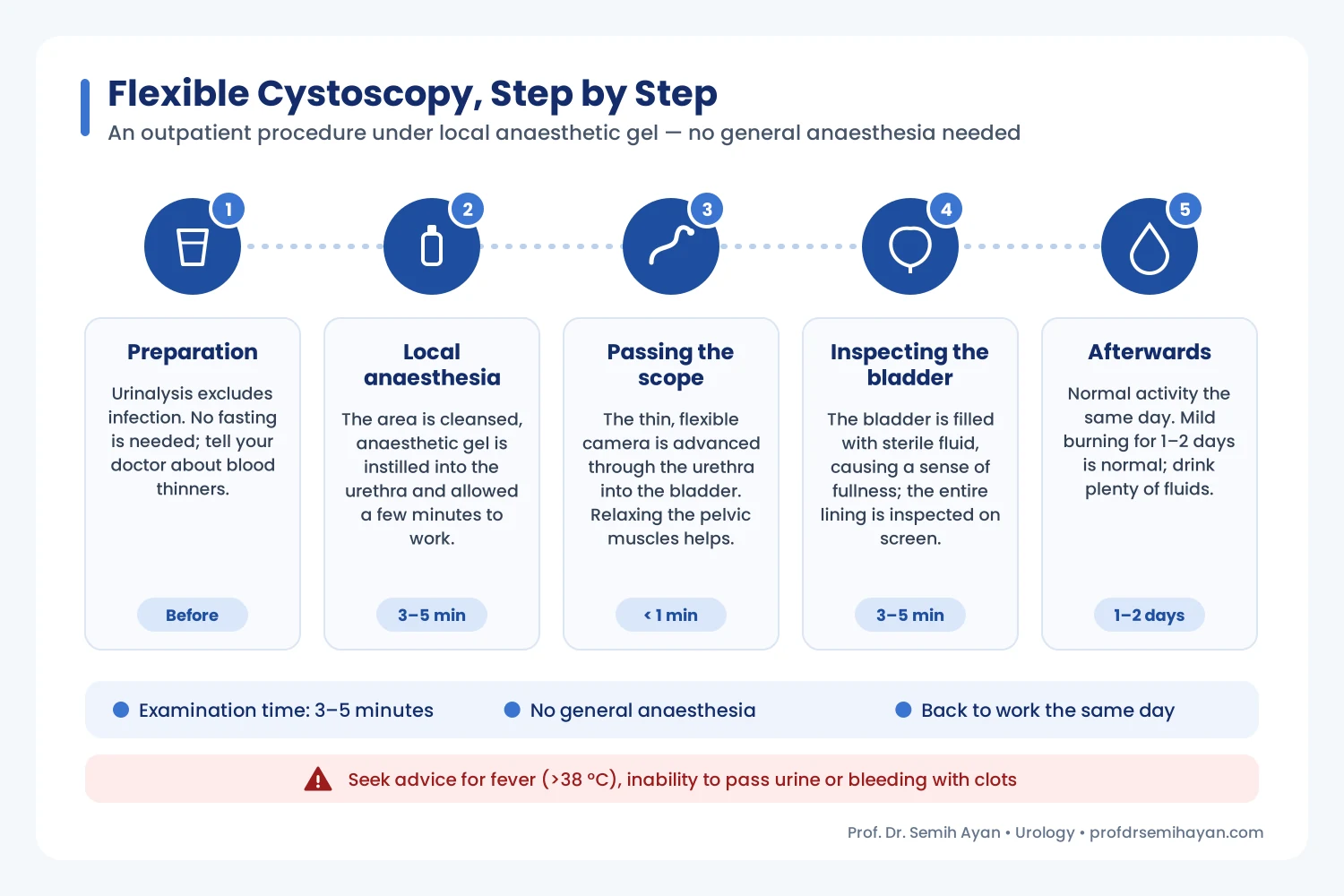
- Preparation: You empty your bladder before the procedure. Men usually lie flat on their back, and women lie in the gynaecological examination position.
- Cleansing and local anaesthesia: The genital area is cleaned with an antiseptic solution and covered with sterile drapes. A lubricating gel containing local anaesthetic (lidocaine) is instilled into the urethra, and a few minutes are allowed for it to take effect.
- Advancing the instrument: The flexible cystoscope is gently advanced through the urethra into the bladder. In men, a brief sensation of pressure may be felt as it passes the prostate and sphincter region; relaxing the muscles at this moment, "as if passing urine", makes the passage easier.
- Examining the bladder: The bladder is filled with sterile fluid, during which you will feel a sense of fullness and an urge to pass urine. All of the bladder walls, the ureteric orifices (where the tubes from the kidneys open into the bladder) and the bladder neck are carefully inspected. The flexible instrument is bent back on itself (retroflexion) so that the bladder neck can also be viewed from behind.
- Completion: The instrument is withdrawn and the procedure is over. The findings are often reviewed with you on the screen and shared on the same day.
The examination itself usually takes 3–5 minutes, or 15–20 minutes in total including preparation.
How is a cystoscopy done in women?
In women the urethra is short and straight, approximately 4 cm long. For this reason, cystoscopy is generally an easier and less uncomfortable procedure in women. The patient lies in a position similar to that used for a gynaecological examination; the rest of the procedure is the same as in men. A planned cystoscopy is usually postponed until after the menstrual period, both so that blood does not obscure the view and for the patient’s comfort; in urgent situations, however, it can be performed during menstruation.
Does a cystoscopy hurt?
The great majority of patients describe flexible cystoscopy not as "pain" but as a brief sensation of burning, pressure and urgency. Studies have found that the pain scores reported during flexible cystoscopy are low. Several factors are known to reduce discomfort:
- Applying the local anaesthetic gel and allowing a few minutes for it to work,
- Breathing deeply and slowly and relaxing the pelvic floor muscles,
- Being able to watch the procedure on the screen: a study in men showed that patients who watched the procedure on the monitor reported less pain,
- A gentle, unhurried technique in experienced hands.
Rigid cystoscopy, by contrast, is performed under anaesthesia, so no pain is felt during the procedure.
A similar picture emerges from what patients say about cystoscopy, a frequent subject of online searches: a significant proportion of patients report that the procedure was much quicker and easier than they had expected. Much of the anxiety stems from not knowing what the procedure involves, which is why asking your doctor all of your questions beforehand is the best preparation.
Recovery after a cystoscopy: what to look out for
After a flexible cystoscopy you can return to work and to your normal daily activities on the same day. In the first 1–2 days, the following are considered normal:
- Mild burning when passing urine,
- Passing urine more often,
- A slightly pink colour or a few drops of blood in the urine.
Drinking plenty of fluids (2–2.5 litres a day) during this period helps these symptoms settle quickly. If you have had a rigid cystoscopy under anaesthesia, you should not drive that day and should go home with a companion. If a biopsy was taken, strenuous exercise and sexual intercourse should be avoided for as long as your doctor advises, because of the risk of bleeding.
You should contact your doctor or attend the emergency department in the following situations:
- A temperature above 38 °C with shivering,
- Being unable to pass urine,
- Bleeding with clots, or bleeding that is getting heavier,
- Pain and burning that last longer than 2–3 days or are getting worse.
What are the risks of cystoscopy?
Cystoscopy is a safe procedure. The most common problem is a urinary tract infection, which develops in a small proportion of patients. Temporary bleeding is common, inability to pass urine (urinary retention) is rare, and injury to the urethra or bladder is a very rare complication.
Can another test replace cystoscopy?
No. Ultrasound and computed tomography (CT) are valuable for assessing the kidneys and upper urinary tract, but small and flat tumours of the bladder, particularly carcinoma in situ, can be missed by these methods. The CT technique known as "virtual cystoscopy" cannot obtain tissue samples and cannot show flat lesions. Urine tests complement cystoscopy but do not replace it. For this reason, current guidelines regard cystoscopy as the cornerstone of bladder tumour diagnosis and follow-up. Techniques available in some centres, such as blue-light cystoscopy (photodynamic diagnosis) and narrow-band imaging (NBI), make it easier to detect tumours that are difficult to see under standard white light.
Key point: Flexible cystoscopy is an examination that does not require a general anaesthetic, takes only a few minutes and is well tolerated by most patients. Putting off a cystoscopy that has been recommended for blood in the urine because of anxiety can delay the diagnosis of a bladder tumour.
Frequently Asked Questions
How long does a cystoscopy take?
With flexible cystoscopy, the examination usually takes 3–5 minutes, or 15–20 minutes in total including preparation. With rigid cystoscopy, the duration depends on the intervention being performed.
Is a cystoscopy done under general anaesthetic?
Flexible cystoscopy is performed with a local anaesthetic gel, without a general anaesthetic. When interventions such as a biopsy, tumour removal or stone fragmentation are required, rigid cystoscopy is carried out under spinal or general anaesthesia.
Is it normal to bleed after a cystoscopy?
During the first 1–2 days, the urine may be slightly pink and a few drops of blood may be seen. If there is bleeding with clots, bleeding that is getting heavier or you are unable to pass urine, you should contact your doctor.
Can a cystoscopy detect cancer?
Cystoscopy allows tumours in the bladder to be seen. A definitive diagnosis is made by pathological examination of a tissue sample taken from the suspicious area, or of the tumour once it has been removed.
When can I go back to work after a cystoscopy?
You can return to work on the same day after a flexible cystoscopy. After procedures performed under anaesthesia, your doctor will advise on the recovery period according to the procedure carried out.
Do I need antibiotics after a cystoscopy?
Routine antibiotics are not required after diagnostic flexible cystoscopy in healthy patients. In patients with risk factors, or when an intervention has been performed, your doctor will recommend antibiotics where they consider it necessary.
Appointments and Information
If a cystoscopy has been recommended because of blood in the urine, bladder tumour surveillance or unexplained urinary symptoms, and you have questions about the procedure, you can book an appointment for a urological assessment. Prof. Dr. Semih Ayan — Urology and Uro-oncology | Florya Medical Park, Istanbul · Tel: +90 533 662 77 97 · Instagram: @prof.dr.semihayan
This article is intended for general information only and does not constitute individual medical advice. Please consult your physician for diagnosis and treatment.
References
- European Association of Urology. EAU Guidelines on Non-muscle-invasive Bladder Cancer (TaT1 and CIS). Arnhem: EAU Guidelines Office; 2025. uroweb.org/guidelines/non-muscle-invasive-bladder-cancer
- Barocas DA, Boorjian SA, Alvarez RD, et al. Microhematuria: AUA/SUFU Guideline. J Urol 2020;204(4):778-786.
- European Association of Urology. EAU Guidelines on Urological Infections. Arnhem: EAU Guidelines Office; 2025. uroweb.org/guidelines/urological-infections
- Patel AR, Jones JS, Babineau D. Lidocaine 2% gel versus plain lubricating gel for pain reduction during flexible cystoscopy: a meta-analysis of prospective, randomized, controlled trials. J Urol 2008;179(3):986-990.
- Patel AR, Jones JS, Angie S, Babineau D. Office based flexible cystoscopy may be less painful for men allowed to view the procedure. J Urol 2007;177(5):1843-1845.