Recurrent Urinary Tract Infections: Etiology, Risk Factors, and Prevention Strategies

A burning sensation during micturition, increased urinary frequency, mild suprapubic pressure — when these symptoms recur two, three, or even four times a year, the underlying problem is not coincidence but a clinically defined entity known as recurrent urinary tract infection (rUTI). As one of the most common reasons for urological consultation, particularly among female patients, recurrent UTI is largely preventable through accurate diagnosis and evidence-based behavioral modifications.
This article addresses the pathophysiological mechanisms driving recurrence, the clinical scenarios that warrant further urological investigation, and the preventive measures supported by current medical guidelines.
Definition of Recurrent Urinary Tract Infection
According to the European Association of Urology (EAU) guidelines, recurrent urinary tract infection is defined as the occurrence of at least two culture-proven UTI episodes within 6 months, or three or more episodes within 12 months.
Recurrent UTIs are classified into two principal categories:
- Reinfection: Each episode is caused by a different microorganism. This pattern accounts for the majority of cases.
- Persistent (bacterial persistence) infection: The same pathogen reappears shortly after completion of therapy. This pattern often indicates an underlying anatomical abnormality — such as urolithiasis, bladder diverticulum, indwelling catheter, or vesicovaginal fistula — and mandates comprehensive urological evaluation.
This distinction is clinically critical, as therapeutic strategies differ substantially: reinfection is generally managed through behavioral interventions and prophylaxis, whereas persistent infection requires treatment of the underlying source.
Etiology of Recurrent Urinary Tract Infections
Recurrence is rarely attributable to a single cause; it typically results from the convergence of multiple predisposing factors.
- Anatomical Factors
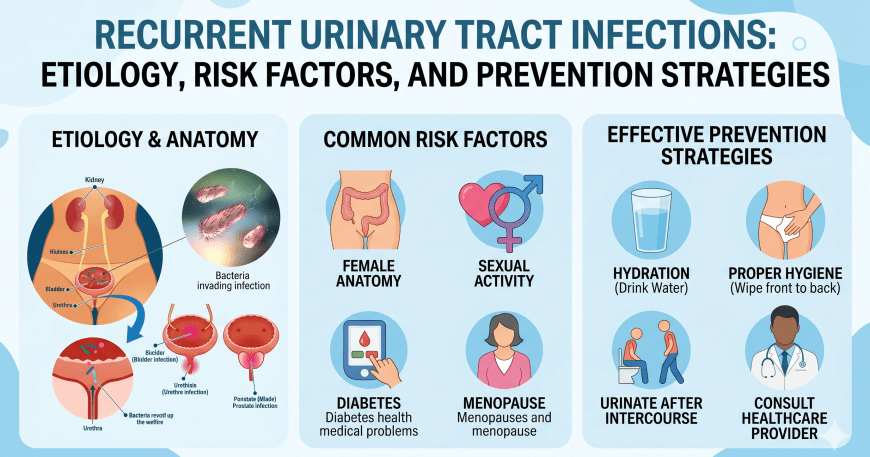
The short female urethra (approximately 4 cm) and its proximity to the anus facilitate ascending colonization of the urinary tract by Escherichia coli, the predominant uropathogen originating from the gastrointestinal flora. In men, recurrent UTI almost invariably indicates an underlying pathology such as benign prostatic obstruction, bladder outlet obstruction, urethral stricture, or incomplete bladder emptying (elevated post-void residual urine).
- Hormonal Changes
The decline in circulating estrogen during the postmenopausal period reduces vaginal Lactobacillus populations, leading to an elevated vaginal pH and increased susceptibility to uropathogen colonization. Estrogen deficiency is one of the most significant contributors to recurrent UTI in postmenopausal women.
- Sexual Activity
Mechanical translocation of periurethral bacteria into the bladder during intercourse is a well-established mechanism, particularly in young, sexually active women. This clinical pattern is historically referred to as “honeymoon cystitis.”
- Diabetes Mellitus and Immunosuppression
Poorly controlled diabetes mellitus promotes bacterial proliferation due to glycosuria. Immunosuppressive therapy, autoimmune disorders, and chronic systemic diseases similarly predispose patients to recurrent infections.
- Urological Conditions
- Renal and bladder calculi: Bacterial biofilms on stone surfaces are highly resistant to antimicrobial therapy.
- Vesicoureteral reflux: Retrograde flow of urine from the bladder to the upper urinary tract.
- Neurogenic bladder dysfunction: Impaired bladder emptying.
- Indwelling urinary catheters: Long-term catheterization remains one of the most important risk factors for recurrent and complicated UTI.
- Genetic Predisposition
A family history of recurrent UTI in first-degree female relatives is associated with significantly elevated risk. This predisposition is thought to relate to enhanced uroepithelial adherence of uropathogens in genetically susceptible individuals.
Clinical Presentation and Red Flags
Typical lower urinary tract symptoms include dysuria, urinary frequency, urgency, cloudy or malodorous urine, and suprapubic discomfort. However, certain findings require urgent evaluation:
- High-grade fever (>38.5 °C) and chills
- Flank or costovertebral angle pain
- Nausea and vomiting
- Gross hematuria
- Any suspected UTI during pregnancy
- Failure of symptom resolution within 48–72 hours of appropriate therapy
These signs may indicate progression to pyelonephritis, which may require hospitalization and parenteral antimicrobial therapy.
Diagnostic Evaluation
In patients with recurrent UTI, diagnosis extends well beyond a single laboratory test. The standard workup includes:
First-line investigations: Urinalysis and urine culture with antibiotic susceptibility testing. Culture-guided therapy is essential, given the rising prevalence of antimicrobial resistance largely attributable to widespread empirical prescribing.
Advanced investigations (for recurrent cases): Urinary tract ultrasonography, computed tomography when indicated, post-void residual urine measurement, uroflowmetry, and cystoscopy in selected patients.
A structured evaluation to exclude anatomical or functional abnormalities is mandatory in every patient presenting with recurrent UTI, as it forms the foundation for individualized management.
Prevention of Recurrent Urinary Tract Infections
Preventive strategies, in accordance with evidence-based medicine, can be categorized into three groups.
Behavioral and Lifestyle Modifications
Adequate fluid intake: Daily intake of at least 1.5–2 liters of water promotes regular bladder emptying and mechanical clearance of bacteria. A landmark randomized controlled trial published in 2018 (Hooton et al., JAMA Internal Medicine) demonstrated that increasing daily water intake by 1.5 liters reduced UTI recurrence by nearly half in premenopausal women with recurrent cystitis.
Avoidance of voiding postponement: Withholding urine allows bacterial multiplication within the bladder; timely voiding is essential.
Post-coital voiding: Urinating within 15 minutes after sexual intercourse facilitates mechanical clearance of bacteria translocated to the urethra.
Hygiene practices: Front-to-back wiping after defecation, avoidance of perfumed sanitary products and vaginal douching, and the preference for cotton underwear.
Management of constipation: Chronic constipation increases perineal bacterial load and constitutes an underrecognized risk factor for recurrent UTI.
Non-Antimicrobial Prophylactic Approaches
D-mannose: A simple sugar that inhibits adhesion of type 1-fimbriated E. coli to the uroepithelium, thereby promoting its clearance through micturition. Several studies have shown promising results for prophylaxis, although standardization of preparations varies and clinical use should be guided by a physician.
Cranberry products: Proanthocyanidins present in cranberry have long been investigated for their anti-adherence properties. Although current guideline recommendations remain limited due to inconsistent evidence, certain patients may derive symptomatic benefit.
Probiotics: Preparations containing specific Lactobacillus strains may help restore protective vaginal flora.
Vaginal estrogen therapy: Topical estrogen application is a guideline-recommended, evidence-based intervention for postmenopausal women with recurrent UTI and should be considered in collaboration with the gynecologist.
Antimicrobial Prophylaxis
When behavioral and non-antimicrobial measures fail, continuous low-dose antibiotic prophylaxis or post-coital single-dose prophylaxis may be considered under medical supervision. Therapeutic decisions must be individualized based on culture results and local resistance patterns. Indiscriminate antibiotic use both promotes resistance and disrupts the gut microbiota.
Immunoprophylaxis and Emerging Therapies
Urinary tract immunostimulants (vaccines) have emerged as a therapeutic option in recent years, particularly in Europe. These oral or intramuscular preparations stimulate immune responses against common uropathogens and have been shown to reduce recurrence rates in selected patient populations. Although availability is currently limited in some regions, immunoprophylaxis is becoming an increasingly relevant option in selected patients.
When to Consult a Urologist
Urological evaluation is recommended for any patient experiencing more than two UTI episodes within a year. The following clinical scenarios warrant prompt specialist referral:
- Any episode of UTI in male patients
- Gross hematuria
- Treatment-refractory or rapidly recurring infections
- History of urolithiasis
- Diabetes or immunocompromised states
- Pregnancy or pregnancy planning
Recurrent UTI is not merely a quality-of-life issue; if left untreated, it may lead to renal scarring, urosepsis, and the emergence of multidrug-resistant pathogens. Therefore, dismissive management should be replaced by systematic investigation of underlying causes.
Frequently Asked Questions
Can recurrent urinary tract infections be a sign of cancer? UTI itself is not a manifestation of malignancy. However, in patients over 40 years of age, the co-occurrence of recurrent infection and hematuria may necessitate evaluation for urothelial carcinoma. Therefore, hematuria should never be disregarded.
Do urinary tract infections resolve spontaneously? In very mild cases, symptoms may regress with adequate hydration; however, untreated bacterial infection carries the risk of ascending to the kidneys. Culture-proven UTI should not be managed without medical supervision.
Are urinary tract infections dangerous during pregnancy? UTIs in pregnancy are associated with preterm labor and pyelonephritis and require close monitoring. Even asymptomatic bacteriuria detected on routine urine culture must be treated during pregnancy.
Is increased water intake alone sufficient for prevention? Adequate hydration is an important preventive measure, but it does not, in isolation, eliminate the recurrence of UTI in all patients. Underlying anatomical or functional contributors must be excluded when present.
Is alcohol consumption beneficial during UTI treatment? No. Contrary to popular belief, alcohol provides no therapeutic benefit; it may irritate the bladder mucosa, aggravate symptoms, and interact with certain antibiotics.
Does cranberry juice prevent urinary tract infections? Evidence regarding the protective effect of cranberry products remains inconsistent. While some patients may benefit symptomatically, cranberry should not be regarded as a substitute for established therapeutic interventions.