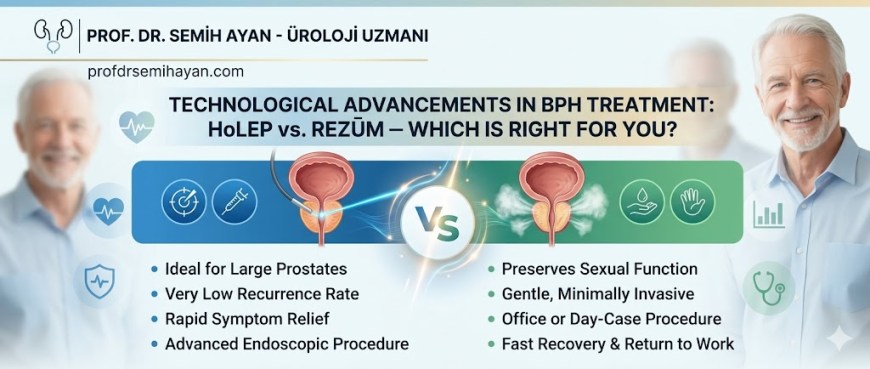
Technological Advancements in BPH Treatment: HoLEP vs. Rezūm – Which is Right for You?

Benign Prostatic Hyperplasia (BPH), a prevalent condition affecting men as they age, can significantly diminish quality of life. Fortunately, urological surgery has evolved far beyond traditional open procedures that required long hospital stays and invasive incisions. In 2026, the two leading “gold standard” minimally invasive therapies are HoLEP and Rezūm.
This comprehensive guide examines the technical nuances, clinical outcomes, and patient selection criteria for these two revolutionary treatments.
1. HoLEP (Holmium Laser Enucleation of the Prostate)
HoLEP is widely regarded as the only endoscopic procedure as effective as open prostatectomy, regardless of the prostate’s size. It utilizes high-powered Holmium laser energy to anatomically enucleate the obstructive tissue.
Procedural Overview
Using a specialized endoscope inserted through the urethra, the surgeon uses the laser to peel away the prostatic adenoma from its outer capsule—similar to removing the fruit of an orange from its rind. Once the tissue is moved into the bladder, a device called a morcellator is used to fragment and aspirate the tissue for removal.
Key Advantages of HoLEP:
No Size Limitations: Unlike many endoscopic methods, HoLEP is highly effective for massive prostates (exceeding 150–200 grams).
Minimal Recurrence Rate: Because the obstructive tissue is entirely removed, the risk of regrowth is exceptionally low (<2% over a lifetime).
Immediate Hemostasis: The laser provides excellent coagulation, minimizing bleeding risks and allowing for catheter removal within 24 hours.
Pathological Analysis: Since the tissue is physically removed rather than ablated, it can be sent for biopsy to rule out incidental prostate cancer.
2. Rezūm (Water Vapor Thermal Therapy)
Rezūm is a “ultra-minimally invasive” procedure that utilizes convective water vapor energy rather than surgical cutting. It has become a preferred “office-based” procedure for patients seeking rapid recovery.
Procedural Overview
The procedure involves injecting sterile water vapor (steam) directly into the prostate via a needle tip. This thermal energy disrupts the cell membranes of the hyperplastic tissue, leading to targeted cell death (necrosis). Over several weeks, the body naturally reabsorbs the treated tissue, widening the urinary channel.
Key Advantages of Rezūm:
Preservation of Sexual Function: One of Rezūm’s most significant clinical benefits is the near-zero risk of retrograde ejaculation (dry orgasm).
Flexible Anesthesia Options: It is ideal for high-risk surgical candidates or elderly patients, as it can be performed under local anesthesia or light sedation.
Efficiency: The procedure typically takes 10–15 minutes, and most patients are discharged the same day.
Comparative Analysis: HoLEP vs. Rezūm
| Feature | HoLEP | Rezūm |
| Duration of Procedure | 60 – 120 Minutes | 10 – 15 Minutes |
| Hospital Stay | 1 Night | Same-day Discharge |
| Anesthesia Type | General or Spinal | Local or Sedation |
| Prostate Volume | No limit (Ideal for large glands) | Generally up to 80 – 100 grams |
| Sexual Side Effects | High risk of Retrograde Ejaculation | Minimal to No Risk |
| Long-term Durability | Permanent solution | May require re-treatment in 5-10 years |
Clinical Decision Making: Which Procedure Suits Your Needs?
The optimal choice depends on a thorough urological evaluation, focusing on:
Gland Volume: For prostates exceeding 100g, HoLEP provides superior long-term flow rates.
Patient Priorities: Patients prioritizing a “one-and-done” permanent solution often choose HoLEP. Those prioritizing the preservation of ejaculatory function and rapid return to daily activities often opt for Rezūm.
Comorbidities: Patients on anticoagulants (blood thinners) or those with significant cardiac risks may find Rezūm to be a safer clinical alternative.
Conclusion: Both HoLEP and Rezūm represent the pinnacle of modern urological care. The decision should be made in consultation with your urologist following a detailed urodynamic and ultrasonographic assessment.