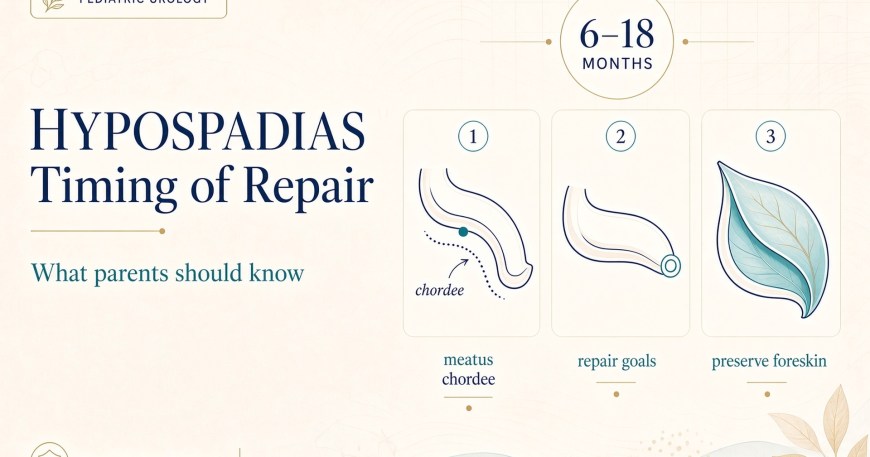
Hypospadias: Timing of Repair and What Parents Should Know

Hypospadias: Anatomy, Timing of Repair, and Long-Term Outcomes
Hypospadias is a congenital anomaly in which the urethral meatus opens on the ventral aspect of the penis rather than at the tip of the glans. It is the second most common congenital genital anomaly in newborn boys after cryptorchidism, affecting roughly 1 in 200-300 male births. The condition is typically identified on the newborn examination, and the message for families is a reassuring one: with correctly timed surgery performed by an experienced surgeon, functional and cosmetic outcomes are good in the great majority of children.
Anatomy and Etiology
Hypospadias results from incomplete tubularization of the urethral plate during embryogenesis. Approximately 70% of cases are distal, with the meatus at or near the glans, while the remaining 30% are proximal — penile, penoscrotal, or perineal — and require more complex reconstruction. The classic triad also includes a dorsally hooded, ventrally deficient prepuce and ventral penile curvature (chordee). The etiology remains incompletely understood; genetic predisposition and hormonal influences during genital development are both implicated, and a positive family history increases risk.
Critical point: Circumcision must be deferred in any boy with hypospadias. The preputial skin is the principal tissue used to construct and cover the neourethra; its loss complicates reconstruction and increases complication rates. Any newborn with an abnormally sited meatus or hooded prepuce should be referred for pediatric urological assessment before circumcision is considered.
When Additional Work-Up Is Required
Proximal hypospadias associated with unilateral or bilateral undescended testes mandates endocrinological and genetic evaluation to exclude a disorder of sex development. Renal and bladder ultrasonography is advised in proximal cases to screen for associated upper urinary tract anomalies. Isolated distal hypospadias does not generally require additional imaging.
Timing of Surgery
EAU/ESPU and American Academy of Pediatrics guidance recommend primary repair between 6 and 18 months of age. The rationale is well established: anesthesia is well tolerated from six months, tissue healing is rapid, the child is not yet aware of his genitalia, and toilet training has not begun. Repair outside this window remains feasible with comparable technical success, but early surgery offers a clear psychological advantage in that the child retains no memory of the procedure.
Surgical Principles
Reconstruction has three objectives: correction of penile curvature, creation of a neourethra of adequate calibre extending to the tip of the glans, and an acceptable cosmetic result. In most distal cases, tubularized incised plate (TIP, Snodgrass) urethroplasty achieves all three in a single stage, usually as a day-case or overnight procedure. Proximal hypospadias with significant chordee may require a staged approach. A fine urethral catheter is left in place for several days postoperatively to protect the repair; adequate hydration, diaper care, and the prescribed dressing regimen are important during this period.
Complications and Long-Term Follow-Up
- The overall complication rate is approximately 10% after distal repair and around 25% in proximal, complex cases.
- The most frequent complications are urethrocutaneous fistula, meatal stenosis, urethral stricture, and glans dehiscence.
- Most are correctable with a second, smaller procedure once tissues have healed sufficiently — an important reassurance for families.
- Voiding function and, in the long term, sexual function are generally well preserved.
- Follow-up should continue to adolescence, as stricture, voiding dysfunction, or recurrent curvature may present years after the initial repair.
In summary, hypospadias is a well-characterized anomaly that, when repaired at the right time and in experienced hands, need not affect the child’s later life. The two decisions that matter most for families are simple: defer circumcision, and seek pediatric urological assessment within the first months of life.
Frequently Asked Questions
Can hypospadias resolve without surgery?
No. The position of the meatus does not change spontaneously, and surgical repair is the definitive treatment. In selected very mild, glanular cases that do not affect voiding or appearance, observation may be reasonable after specialist assessment.
Can my son be circumcised?
Not before repair. The prepuce provides essential tissue for urethral reconstruction and coverage. In most cases circumcision is performed as part of the hypospadias operation itself.
What is the optimal age for surgery?
Current guidelines recommend repair between 6 and 18 months of age, when healing is rapid and the child will not remember the procedure. Repair remains successful if performed later.
Will my child void normally afterwards?
Yes — one of the aims of repair is a terminally positioned meatus with a straight, single urinary stream. After successful repair boys can void standing, with a stream close to normal.
Will it affect sexual function or fertility later in life?
Sexual function is generally preserved after repair of isolated hypospadias. Fertility relates less to the hypospadias itself than to associated conditions such as cryptorchidism, which is why both should be assessed together.
|
Appointments and Information If the position of your baby’s urethral opening or the appearance of the foreskin seems unusual, you may schedule an evaluation before planning circumcision. Prof. Dr. Semih Ayan — Urology and Pediatric Urology | Florya Medical Park • Phone: +90 533 662 77 97 • Instagram: @prof.dr.semihayan |
This article is intended for general informational purposes only and does not constitute personal medical advice. Please consult a physician for diagnosis and treatment.
References
- European Association of Urology (EAU). EAU Guidelines on Paediatric Urology. EAU Guidelines Office, 2025. uroweb.org/guidelines/paediatric-urology
- American Academy of Pediatrics, Section on Urology. Timing of Elective Surgery on the Genitalia of Male Children. Pediatrics 1996;97(4):590-594.
- van der Horst HJR, de Wall LL. Hypospadias, all there is to know. Eur J Pediatr 2017;176(4):435-441.
- Snodgrass W, Bush N. Tubularized incised plate hypospadias repair: current concepts. J Pediatr Urol 2010;6(6):551-556.